Spirituality v. Magic
Phi-The-Sci: Equilateral Musings

I am not a member of the Church of Jesus Christ of Latter-Day Saints (colloquially known as “Mormonism”). I have never been a member and have no plans of joining. I am an extremely content member of PCUSA (Presbyterian Church (USA)) which is a progressive wing of the Presbyterian Church.
However, the history of the Restoration Movement in the United States (which included the LDS church) is very fascinating simply because the LDS church has documented its history expansively. I live in Utah which is geologically beautiful. Beautiful geology plus an unusual religious movement settling in Utah leads to unusual outcomes. In this setting, I have been reading “Early Mormonism and the Magic World View” by D. Michael Quinn, published in Signature Books. Quinn (now deceased) was professor at USC, and he won many book awards in his lifetime.

Utah (Arches National Park)
This particular book is full of information not just about the early American Restoration Movement but also about the intricate association between early colonial America and books on magic. According to the book, a large number of Americans early on in the country’s founding were not religious. Such an idea makes sense. People often lived far, far away from any civilization which included churches.
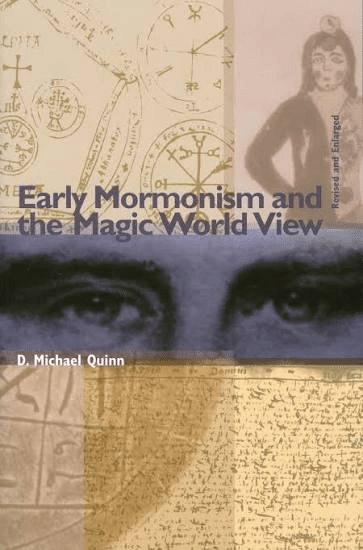
I was intrigued by this quote from the book… “One traditional distinction is that religion is supplicative and magic coercive in intent. Anthropologist Lucy Mair wrote that ‘the difference between religion and magic…might be epitomized as the difference between communicating with beings and manipulating forces.’”
Whoa. Let’s think about these words.
I’m a religious person so I do pray. When I was much younger, I prayed for specific things to happen…to get a specific toy, to get a girl in school to like me. Weirdly, even before I went down the route of theological studies, I had quit praying for direct intervention by God. I can think of some reasons for this change to have happened.
I really came to understand that many of the stories in the Bible are mythic. Some readers of my blog are probably thinking, “DUH!”, but one would be amazed that even growing up in a highly educated home, people just can accept stories they hear in church. My parents knew these stories and told me these stories, but as I got older, I came to understand that my parents either never believed the stories or really didn’t care if they were real or not.
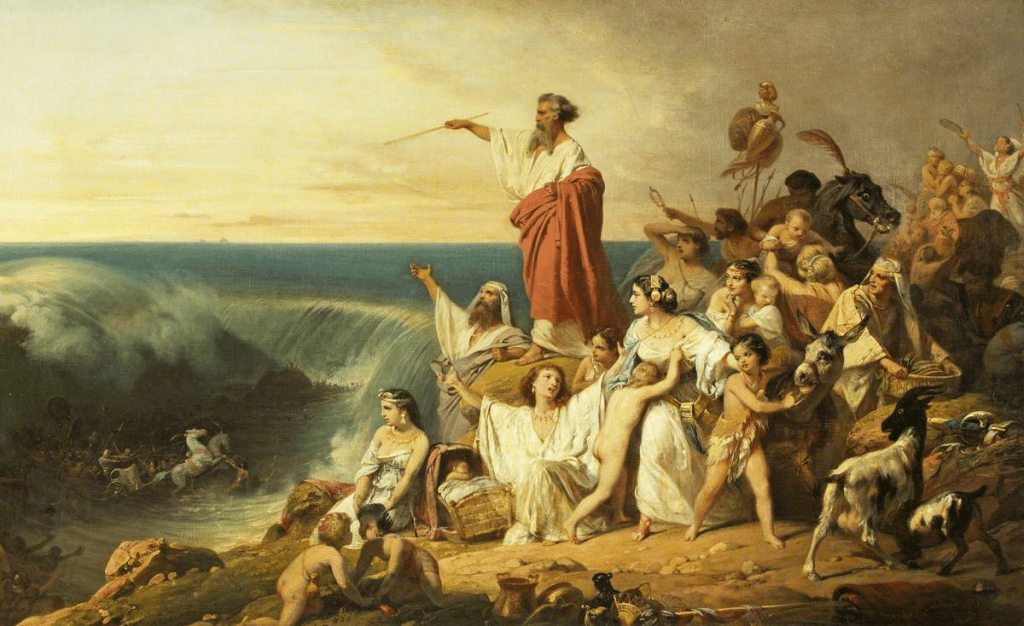
Moses Crossing the Red Sea
People talk about moments of the “dark night of the soul.” My “night” came about when I dug into the Exodus story only to realize that it didn’t happen. Sure, some small migration of individuals up to the Levant from Egypt may have happened. A small migration may have changed into a legend over time which consisted of millions of migrating Hebrews, but the events of the Exodus didn’t happen. There is zero archeological evidence.
In contrast, there is evidence of the Battle of Thermopylae which also has mythic dimensions, but there is no evidence of the Exodus. Hence, there is no evidence of “manipulating forces” based on all of the Exodus stories (i.e., magic).
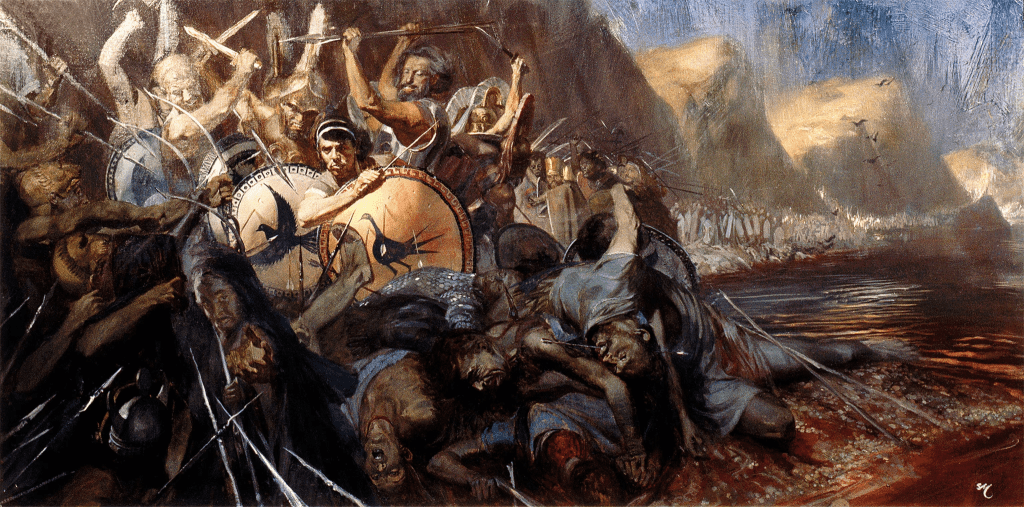
Battle of Thermopylae
Second, my job in healthcare. Many people in healthcare take care of dying patients. It is no different in my field. Watching a patient die is especially tough when it happens to a child. Honestly, I’ve seen no miraculous healings, and I have met many, many wonderful families who got blindsided with the death of their child. Many of these families are religious. I have seen no evidence of prayer “manipulating forces” causing miraculous healings (i.e., magic).

So, why do I pray? I had to think about this aspect for my blog today. Let me give you some reasons.
I have tried the agnostic route. It didn’t work for me. Being agnostic or atheist works for many wonderful people, many of whom are my friends. It really didn’t work for me, although in the end, every human probably is agnostic as we can’t prove or disprove God. I guess my genetics, and more importantly, my epigenetics made me who I am when it comes to believing in God.
Bible stories often are mythic. Myth, in my opinion, is different than most fantasy stories. Myths tend to be very old, and although they may have magical qualities, they say something profound about the human condition. Much work on the importance of myth has been done here in the realm of sociology and psychology. See here and here. So, I pray in the setting of myths because ancient stories tell me deep truths about human nature and its relationship to a potential God.
Noah’s Ark
I pray in the setting of process theology which is one of my theological interests. I have posted many times about this type of theology. In other words, I pray that entities accept God’s lure for creativity. God lures; God does not force. As an example, if I pray for a war to stop, then I am praying for all involved combatants (especially their leaders) to hear God’s lure for the good…for war to stop. I realize it can be extremely difficult, especially for humans like myself, to hear God’s lure. In the setting of open & relational theology (which I also have posted about before), I am convinced that this lure is divine love.
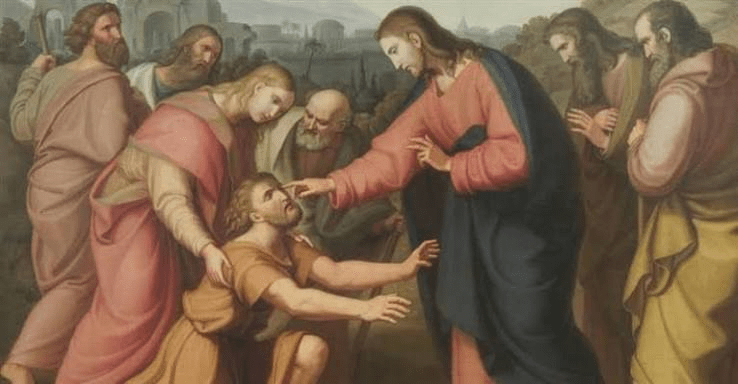
Jesus Healing the Blind Man
Finally, perhaps there has been contact with Divinity in the past that makes me think God may exist. I’m a Christian, and if I believe in the hypostatic union (Jesus being fully God and fully man) of the Christ event, then perhaps in the extreme circumstances of God touching our species at specific events, it may be possible for miracles to occur. If miracles have occurred in history because our species has interacted with God, then perhaps praying is a way to communicate with God. I’m not convinced, of course. This idea is just a theological theory. A correlative idea would be in the Hadith when Muhammad had water miraculously gush forth from his hands. Some other ideas such as the Buddha having a massive tongue that could cover his whole face (as described in the Pali Canon) seem less likely. However, I am not going to judge this Buddhism story as I have enough crazy stories in my own religious tradition.

Image made by Gemini Advanced
Great post, thanks!
Process theology and open and relational theology got me praying petitionary prayers again. Before them, I felt like trying to convince God to do something, or trying to inform God of needs, were absurd if God cared and knew stuff already. But the luring concept, as you describe, plus the idea that not just God lures but we lure too, made it make sense to think that my ardent feelings can stream out into the universe and into the mind of God and maybe some others like me can prehend them and help bring about the good (I hope) ends I pray for.
That’s a solid definition. Communication vs manipulation, but there’s a lot of nuance here. After all, speech itself is manipulative. To be heard is to be experienced. You are inducing that. Context alters meaning and you’re adding context when you speak such to cause experience. Even your own.
How vs why, science vs philosophy, magic as science, religion as ontology, all of it cosmology in a sense.
Also I think faith is a bit like a fetish, you acquire it in youth and then it stays with you regardless of other factors. The brain loses plasticity as it developes.
Your never seeing miracle healings is provable in a narrow sense. It should be a genuine theological question why god has never seen fit to regrow a limb. Though now we’re in an era where that could be faked, and history edited to make accounts of it plentiful.
As a dim witted teenager I genuinely believed bringing the problem of evil to religious people would change them. To this day I wonder how much of my faith in discourse is equally firm wired. I think like it’s pointless but I keep trying in some contexts.
Desperation? Biological lock? Who knows. I lost interest in god when it became clear that there was legitimate criteria to judge him. His entire value proposition was experience management. Threats and bribes basically. I didn’t know this consciously of course but basically he got demoted.
It’s like how in school you eventually realize the bell out ranks the teacher. And the teachers out rank your parents, and the cops out rank the teachers, and so on.
Sorting all this out is how I ended up where I am. It’s All just experience. And the structure and valence of it given.
God can exist within experience, but basically he’s just a very powerful alien. Experience only allows room for a very poor quality god. Calling it a god is misleading imo. Epistemology is this type of thinking dialed up to 11. All the clever god contradictions are like epistemology 101.
Great post man, thanks for the inspiration.
I’m tired of being homeless.
Side note, prayer and wishing are very related, and to me wishing is a baited hook. I maintain that any wish can be twisted. (Monkey paw, evil genie, etc.) A wish can be failed also, as in “be careful what you wish for.”
I don’t have any tattoos because I could never think of anything worthy to print forever on my skin. I don’t like decisions I can’t undo. I don’t like constraining my future self.
Similarly, I don’t have any prayers with any chance of being answered even in spirit, if I could even form them satisfactorily in the first place.
Reality is comprehensively broken. And praying to the inventor of cancer seems unwise. If it clearly won’t save me, it feels like a right to remain silent type deal. https://philpapers.org/rec/SERRRT-3 and https://philpapers.org/rec/SERTEC